
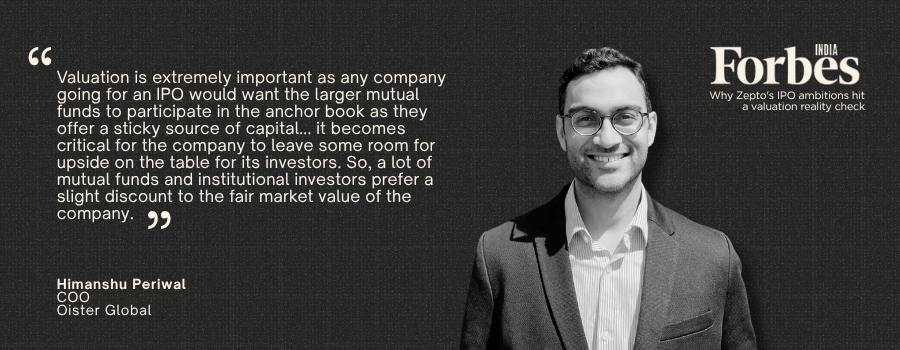
Himanshu Periwal, COO, Oister Global, was featured in Forbes India’s Pricing Zepto, which examined the valuation debate ahead of Zepto’s proposed IPO. He shared his perspective on IPO pricing, institutional participation and why leaving some upside for incoming investors can be important in building a strong anchor book.
TL;DR
- Zepto’s journey towards an IPO highlights a recurring challenge for high-growth private companies: the valuation that works in private markets may not be the valuation public-market investors are willing to accept.
- Zepto was valued at approximately $7 billion in its October 2025 private funding round, while large domestic institutional investors subsequently pegged its pre-money valuation at around $2.5 billion and post-money valuation at roughly $3 billion, according to Forbes India.
- The underlying business continues to grow rapidly. Revenue increased from ₹4,455 crore in FY24 to ₹11,110 crore in FY25, while losses widened from ₹1,214.79 crore to ₹4,699.71 crore.
- Himanshu Periwal, COO of Oister Global, argues that IPO valuation must leave enough upside for incoming institutional investors, particularly mutual funds participating in the anchor book. His view is that institutional investors often prefer some discount to perceived fair market value.
- The broader lesson extends beyond Zepto: an IPO is not simply the final valuation event for a private company. It is a transition between two different pools of capital, with different expectations of growth, profitability, liquidity and price.
Quick Answer: How Is a Private Company Valued Before an IPO?
A private company’s last funding-round valuation does not automatically become its IPO valuation.
As a company moves from private to public markets, a new set of investors must underwrite its growth, profitability, cash flows, competitive position and listed-market comparables. That can result in an IPO valuation that is above or below the company’s last private-market valuation.
Zepto provides a particularly interesting case.
The quick-commerce company raised $450 million at a $7 billion valuation in October 2025. But ahead of its proposed IPO, Forbes India reports that large domestic institutional investors pegged the company at approximately $2.5 billion pre-money and $3 billion post-money.
The question is therefore no longer simply how quickly Zepto can grow.
It is what price public-market investors are willing to pay for that growth.
Why Can IPO Valuations Differ From Private-Market Valuations?
Private and public markets price companies under different conditions.
Private funding rounds involve a relatively small number of investors negotiating an investment at a particular point in a company’s development. Public markets introduce a much broader investor base, continuous price discovery, listed competitors and greater scrutiny of profitability and cash generation.
That distinction becomes especially important for companies growing rapidly while continuing to consume significant amounts of capital.
Zepto illustrates both sides of that equation.
| Feature | Dome Valve | Butterfly Valve |
|---|---|---|
| Sealing method | Inflatable pneumatic seal | Fixed/rigid sealing arrangement, depending on design |
| Flow path when open | Full‑bore, unobstructed flow | Disc remains within the flow path |
| Seal contact during movement | No seal contact while dome is moving | Design‑dependent; disc and seat interaction can contribute to wear |
| Abrasive material handling | Well suited to abrasive bulk solids | Application dependent |
| Dense phase conveying | Well suited for pressure‑tight isolation | Depends on valve design and application |
| Material accumulation | Dome design helps minimize obstruction | Disc and shaft can interact with the material stream |
| Maintenance objective | Long service life and reduced seal wear | Depends strongly on seat/disc material and duty |
The company has demonstrated extraordinary growth. But public-market investors must simultaneously decide what that growth is worth relative to losses, future profitability and listed competitors.
Why Does IPO Pricing Need to Leave Upside for Investors?
This is where IPO pricing becomes more than an exercise in determining theoretical fair value.
Speaking to Forbes India, Himanshu Periwal, COO of Oister Global, highlighted the importance of attracting large institutional investors into the anchor book.
His argument is straightforward: a company naturally wants to maximise its valuation, but incoming institutional investors also need a reason to participate.
That can mean leaving some upside on the table rather than pricing an IPO at the absolute upper end of what the company believes it is worth.
As Periwal explained, many mutual funds and institutional investors prefer some discount to perceived fair market value because it provides a margin for upside after listing.
The objective, therefore, isn’t necessarily to extract the maximum possible valuation on IPO day.
It is to find a price at which existing shareholders and new investors can both participate in the company’s next phase of value creation.
What Does Zepto’s Valuation Debate Tell Us About Private Markets?
Zepto’s case points to something larger than quick commerce.
India is producing a growing cohort of companies that have spent years building themselves in private markets before approaching public investors.
That transition creates a new phase of price discovery.
Private-market investors may have entered much earlier, when the business was smaller and uncertainty considerably greater. IPO investors enter later, with more operating history but also a much more visible price and a different set of return expectations.
The valuation at which those two pools of capital meet matters.
Price too aggressively and institutional demand can weaken. Price too conservatively and existing shareholders may feel they are giving away value.
The most successful transition is therefore not necessarily the one that produces the highest IPO valuation.
It may be the one that creates the strongest alignment between the investors who funded the company’s private-market journey and those funding its life as a public company.


Forbes India, Pricing Zepto, August 3, 2026.
Forbes, Indian Quick Delivery Unicorn Zepto To Raise $837 Million From IPO, June 2026.
Himanshu Periwal — Oister Global



 Learn More