

Why Are FPIs Returning to India but Choosing Primary Markets Over Listed Stocks?
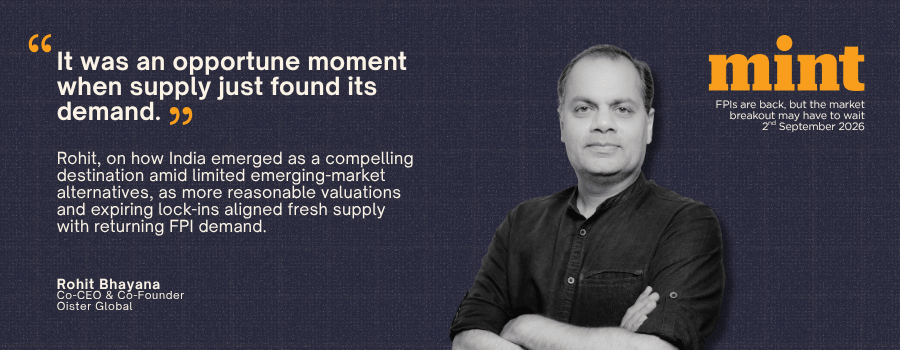
Rohit Bhayana, Co-founder & CEO, Oister Global, was featured in Mint’s analysis of returning FPI flows and their growing preference for IPOs, QIPs and block deals over secondary-market purchases. He shared his perspective on how valuations, global capital allocation and fresh supply are shaping where foreign capital is entering India.
TL;DR
- Foreign portfolio investors (FPIs) are returning to India, but much of that capital is going into IPOs, QIPs and block deals rather than buying listed shares in the secondary market.
- FPIs have invested ₹45,711 crore in India’s primary markets in 2026, while withdrawing nearly ₹2.7 trillion from secondary markets.
- August alone saw nearly ₹1.07 trillion of IPOs, QIPs and secondary-market block trades, the highest monthly level of 2026.
- Block deals reached nearly ₹80,000 crore in August, their highest monthly level in 14 months, as lock-ins expired across a cohort of recently listed companies.
- According to Oister Global co-founder and CEO Rohit Bhayana, the shift reflects a combination of timing, valuations and allocation: global investors are looking beyond crowded AI and data-centre exposures just as Indian valuations have become more reasonable and fresh supply has entered the market.
Quick Answer: Why Are FPIs Buying Indian Primary-Market Deals Instead of Listed Stocks?
Foreign investors are returning to India, but they are increasingly choosing newly available shares through IPOs, QIPs and block transactions instead of buying existing shares on the stock exchange.
That distinction helps explain an apparent contradiction in Indian markets.
The Sensex and Nifty gained only 0.6% and 0.9%, respectively, over the two months covered by Mint’s analysis, despite FPIs putting roughly ₹50,000 crore into Indian equities.
The capital is coming back. It just isn’t necessarily going where headline indices feel it most.
Where Is FPI Money Going in India in 2026?
The divergence between India’s primary and secondary markets is significant.
According to Mint’s analysis, FPIs have invested ₹45,711 crore in India’s primary markets so far in 2026, while withdrawing nearly ₹2.7 trillion from the secondary market.
August provides a particularly clear picture.
Companies raised ₹22,406 crore through IPOs and ₹5,450 crore through QIPs during the month. Together, those offerings represented almost 40% of the ₹29,361 crore that FPIs invested in Indian equities in August.
Meanwhile, block-deal activity surged.
| Market Indicator | 2026 Data |
|---|---|
| FPI primary-market investment | ₹45,711 Cr |
| FPI secondary-market selling | ~₹2.7 trillion |
| August IPO + QIP + block activity | ~₹1.07 trillion |
| August block deals | ~₹80,000 Cr |
| August IPO issuance | ₹22,406 Cr |
| August QIP issuance | ₹5,450 Cr |
The important distinction is that foreign capital inflows do not automatically translate into secondary-market buying.
Why Are Block Deals Surging in India?
Part of the answer is simply timing.
A strong cohort of new-age businesses listed between November 2025 and February 2026. Their six-month shareholder lock-ins have consequently begun expiring in stages since May.
That has created fresh supply as existing shareholders gain the ability to monetise stakes.
As Rohit Bhayana explained to Mint, demand for scaled, category-leading businesses has remained strong even as secondary-market sentiment has been more subdued.
The result is an unusual convergence: investors looking for high-quality Indian assets at the same time that existing shareholders are gaining liquidity.
In Bhayana’s words, it became an “opportune moment when supply just found its demand.”
Why Are Global Investors Looking at India Again?
The other side of the equation is global asset allocation.
Bhayana attributes the shift towards Indian primary markets to a combination of timing, valuations and allocation.
One factor is the reassessment of global exposure to artificial intelligence and data centres. After substantial amounts of capital moved into those themes, some investors have begun looking for opportunities elsewhere.
India is one of relatively few large emerging markets capable of absorbing institutional capital at scale.
At the same time, Indian valuations have become more reasonable, while IPOs, expiring lock-ins and block transactions have created a fresh supply of investable assets.
Investment banks and IPO bookrunners have also been deliberately bringing high-quality FPIs back into India through primary allocations.
For global investors, these transactions can offer another advantage: entry price.
QIPs and block transactions can provide a valuation cushion through discounted pricing. Bhayana notes that discounts alone rarely determine FPI flows, but they can offer some buffer against the impact of a depreciating rupee on dollar-denominated investor returns.
Why Haven’t FPI Inflows Pushed the Sensex and Nifty Higher?
Because where capital enters the market matters as much as how much capital enters it.
When an FPI buys an existing listed share on the stock exchange, that demand can directly influence its market price.
When the same investor participates in an IPO, QIP or large block transaction, the capital is instead absorbing new or newly available supply.
India currently has plenty of that supply.
Recent IPO shareholders are exiting lock-ins. Promoters and institutional shareholders are monetising stakes. Companies are raising fresh capital. Large IPOs remain in the pipeline.
So returning foreign capital is being absorbed by an expanding pool of available equity rather than simply chasing the existing stock of listed shares.
That helps explain why strong headline FPI inflows can coexist with relatively muted index performance.
What Does This Mean for India’s Capital Markets?
The more interesting interpretation may be that India’s capital markets are becoming capable of supporting more forms of liquidity simultaneously.
Companies can raise fresh capital. Early shareholders can monetise positions. Domestic institutions can absorb large transactions. Foreign investors can access businesses through IPO allocations, QIPs and blocks rather than relying solely on secondary-market purchases.
This is also part of a broader change in ownership. According to a JM Financial Institutional Equities report cited by Mint, promoter ownership of Indian equities declined from 53.4% in June 2014 to 50.3% in June 2026.
That is not necessarily a story of capital leaving India.
It is increasingly a story of capital changing hands.
For investors looking at India, the relevant question may therefore no longer be simply whether foreign money is coming back.
It is where that capital is finding its entry point.


Mint, FPIs are back, but the market breakout may have to wait, Abhinaba Saha, 2 September 2026.
Rohit Bhayana, Co-founder and CEO, Oister Global, quoted in Mint.



 Learn More