

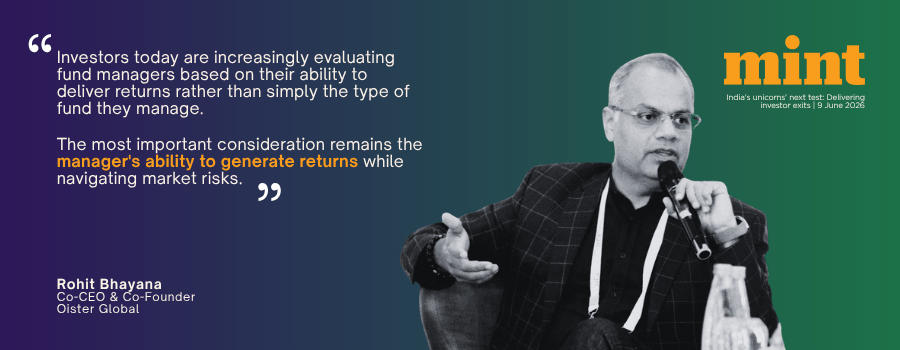
Oister Global Co-CEO and Co-Founder Rohit Bhayana was quoted in Mint on 9 June 2026, offering his perspective on India’s evolving private markets exit landscape and the growing pressure on fund managers to deliver real cash returns to limited partners.
[TL;DR]
- Only 77 of 139 VC/PE-backed Indian unicorns (valued >$1B by end-2022) have generated a liquidity event
- 26 companies including Dream11 and Apna have no visible path to exit as of June 2026
- West Asia war has slowed IPO pipeline — 7–8 additional unicorn listings delayed, not abandoned
- Secondary markets are emerging as the critical bridge, but the ecosystem remains in early stages
The Shift
India’s startup ecosystem has been celebrated globally for minting unicorns at pace, but it has yet to evolve into one that consistently delivers liquidity events and meaningful cash returns for investors. That gap is now being put to the test. As venture capital and private equity firms that backed Indian startups during the 2018–22 funding boom come under pressure to return capital to their limited partners, the conversation has fundamentally shifted — from billion-dollar valuations to actual exits and distributions. The question is no longer how many unicorns India can create. It is how many can convert paper wealth into real returns.
The Numbers That Prove It
- 139 VC and PE-backed Indian unicorns (valued >$1B by end-2022) analysed by Mint / Tracxn
- 77 have generated a liquidity event — including Swiggy and Zomato
- 44 of those 77 went public; 29 exited via acquisition
- 34 companies including BharatPe, boAt, Moglix, and BrowserStack are pursuing liquidity with IPO plans
- 26 companies including Apna and Dream11 have no visible path to exit as of June 2026
- 2 have shut down entirely
- India e-retail at only 1.6% of GDP vs China’s 13–14% — structural headroom exists, but exit infrastructure lags far behind
The Exit Problem Is Real
India’s startup ecosystem has historically offered fewer exit routes than developed markets, and the data confirms it. Of 139 unicorns created through the 2018–22 boom, only 77 have delivered any form of liquidity event — and even those events don’t automatically translate into LP distributions. In the US, large listed companies routinely acquire venture-backed startups for cash and stock at scale — Google’s $32B acquisition of Wiz, CapitalOne’s $5.2B acquisition of Brex. In India, such large strategic buyers are fewer and have historically executed only small-scale M&A. Without that strategic acquirer layer, IPOs remain the primary — and often only — exit mechanism for technology and consumer internet companies. The consequence: earlier-stage investors stay invested significantly longer than originally modelled, stretching fund lifecycles and delaying LP distributions by months or years even after a successful listing.
Where India’s 139 Unicorns Stand Today
| Status | Count | Examples |
|---|---|---|
| Liquidity event achieved | 77 | Swiggy, Zomato |
| Pursuing IPO / exit plans | 34 | BharatPe, boAt, Moglix, BrowserStack |
| No visible exit path | 26 | Apna, Dream11 |
| Shut down | 2 | – |
| Via IPO (of 77 exits) | 44 | – |
| Via acquisition (of 77 exits) | 29 | Unacademy, Rivigo |
3 Risks to Know
- West Asia Geopolitical Overhang — Market volatility following the West Asia war has slowed IPO preparation pace significantly; EY estimates 7–8 unicorn listings that would have occurred have been delayed, and companies are recalibrating valuation expectations to match a more cautious public market
- The Lock-Up Distribution Problem — Unlike the US where funds can distribute listed shares directly to LPs, Indian regulations require investors to fully monetise holdings before making distributions; the gap between a liquidity event and actual LP cash returns can stretch over years
- Valuation Reset Pressure — Many unicorns that raised capital during the 2020–21 funding boom at peak valuations are now reconciling private marks with public market realities; early unicorn listings that struggled post-IPO have made subsequent issuers more cautious about timing and pricing




 Learn More