
Rohit Bhayana on CNBC-TV18: Oister Global’s ₹600 Crore Bet on India’s Deep Tech Missing Middle
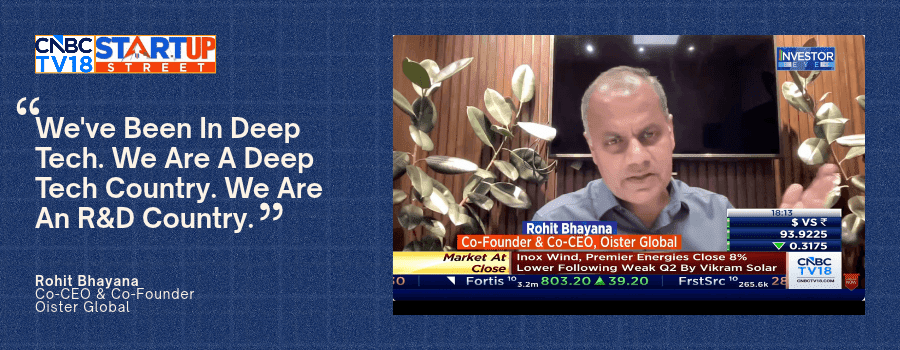
Rohit Bhayana, Co-Founder and Co-CEO of Oister Global, spoke to CNBC-TV18 on its Investor Eye segment on 16 November 2026 about the newly launched Oister Deep Tech Fund. In the eight-minute interview, he explained why growth-stage deep tech capital is scarce in India and how Oister plans to fill the gap.
Watch the full CNBC-TV18 interview here
TL;DR
India’s deep tech companies can now raise early money, but growth capital thins out sharply after Series B. Oister Global’s new ₹600 crore deep tech fund is built to fill that gap.
- The fund will back 8 to 10 growth-stage companies across semiconductors, space tech, defence, advanced manufacturing and quantum technology.
- Only about 5% of deep tech companies reach late-stage funding, down from 74% at seed.
- Oister invests after the “valley of death”: core patents granted, products flight- or field-tested, revenue building.
- A four-point test separates real deep tech from promising technology.
- Exits will come through IPOs, strategic outcomes and India’s growing secondary market.
Quick Answer
The “missing middle” is the funding gap between early-stage deep tech capital and large institutional money. Oister Global’s ₹600 crore fund, a SEBI-registered Category II AIF (₹400 crore corpus plus ₹200 crore greenshoe) targets proven, revenue-generating deep tech companies over a 6-year fund life.
As Featured on CNBC-TV18
| Coverage detail | Information |
|---|---|
| Channel | CNBC-TV18 |
| Programme | Investor Eye |
| Date | 16 November 2026 |
| Duration | About 8 minutes |
| Speaker | Rohit Bhayana, Co-Founder and Co-CEO, Oister Global |
| Topic | Oister Deep Tech Fund and growth-stage deep tech financing in India |
| Watch | Full interview on YouTube |
The fund launch was also covered by Business Standard, YourStory, Inc42 and Entrepreneur India amongst many others
Why the Missing Middle Exists
Deep tech funding in India falls off a cliff after the early rounds. Bhayana shared how quickly the share of companies raising capital thins out at each stage:
| Stage | Share of companies raising |
|---|---|
| Pre-seed to seed | About 74% |
| Series B | About 45–46% |
| Late stage | Below 5% |
He pointed to two causes working together:
- Demand side: very few companies have yet matured to the stage where they need large growth rounds.
- Supply side: most funds are not yet comfortable underwriting late-stage deep tech risk.
Oister’s answer is to enter only once the hardest risks are behind a company. That means core patents granted, products flight- or field-tested, and institutional order books already building.
The Four-Point “Real Deep Tech” Test
Coming in late is only half the thesis; the other half is backing genuine deep tech. Bhayana described four non-negotiables a company must clear before Oister signs a cheque:
| Check | What Oister looks for |
|---|---|
| 1. Fundamental breakthrough | A core advance in physics, chemistry, biology or applied mathematics, aimed at a big problem |
| 2. Tenure | Eight to ten years of deep data and modelling, including the failures it took to get there |
| 3. Global patents | IP protected beyond India, able to hold its ground against Western and Chinese competitors |
| 4. Cross-sector demand | Use cases across multiple private-market industries, not only sovereign or government buyers |
The second point stands out. Oister wants to see that a company has had time to fail and recover, treating that history as proof of durability rather than a red flag.
Concentrated Bets, Shared Runways
With 8 to 10 companies instead of 20 or 30, each investment is a high-conviction bet. Oister does not expect to fund any company alone.
| Fund feature | Detail |
|---|---|
| Typical cheque | Roughly ₹100 crore per company |
| Fund life | 6 to 8 years |
Bhayana said three sources of capital make a ₹100 crore cheque meaningful:
- Co-investors: strong institutional investors participating in the same rounds.
- Government: the Government of India’s RDI fund is now deeply invested in the ecosystem.
- Organic revenue: portfolio companies already fund part of their own runway from customers.
India as the Third Pole of Deep Tech
Asked which sectors offer the best risk-reward, Bhayana argued that India is emerging as a third global pole of deep tech, so no sector is out of reach.
| Pole | Defining strength |
|---|---|
| United States | Capital- and compute-heavy innovation |
| China | State-sponsored manufacturing and minerals |
| India | Deep research, design, and frugal, fast development that lends itself to trusted scale |
He stressed that India is not new to deep tech. The country has spent decades as the world’s hub for global capability centres, running R&D for companies such as Schneider, Bosch, Intel, Cisco and NVIDIA. Government institutions like C-DOT and C-DAC were building advanced computing capability early. In his words, deep tech is India’s natural home turf.
Three Exit Pathways
Oister expects all three exit routes to play out across the portfolio. Bhayana declined to discuss target returns, saying he did not want to solicit investors on air.
| Exit route | When it fits |
|---|---|
| IPO | Mature companies that could reach a listing in two to three years |
| Strategic outcome | Companies so dominant in their technology that acquirers and partners come to them |
| Secondary sale | Available across the portfolio, backed by India’s increasingly active secondary market |
The secondary route ties back to Oister’s wider franchise. Its earlier secondaries work has made the firm a vocal advocate of continuous liquidity in Indian private markets.
Oister Global’s ₹600 Crore Deep Tech Fund Launch | CNBC-TV18 Interview
“We’ve been in deep tech. We are a deep tech country. We are an R&D country.” — Rohit Bhayana, Co-Founder and Co-CEO, Oister Global, speaking to CNBC-TV18


 Call Us